Here’s what India’s top money managers are buying post elections
Get link
Facebook
X
Pinterest
Email
Other Apps
[hfe_template id='11223']
[ad_1]
India’s top money managers, overseeing nearly $120 billion of equity assets, are now favoring shares of large firms with strong fundamentals as this week’s election upset dims the appeal of past winners with sky-high valuations.
Stock pickers at ICICI Prudential Asset Management Co. and HDFC Asset Management Co. are turning wary of small-caps and stocks that look overheated, such as industrials, defense and state-run companies. Nippon Life India Asset Management Ltd. is leaning toward larger companies that are trading at attractive valuations.
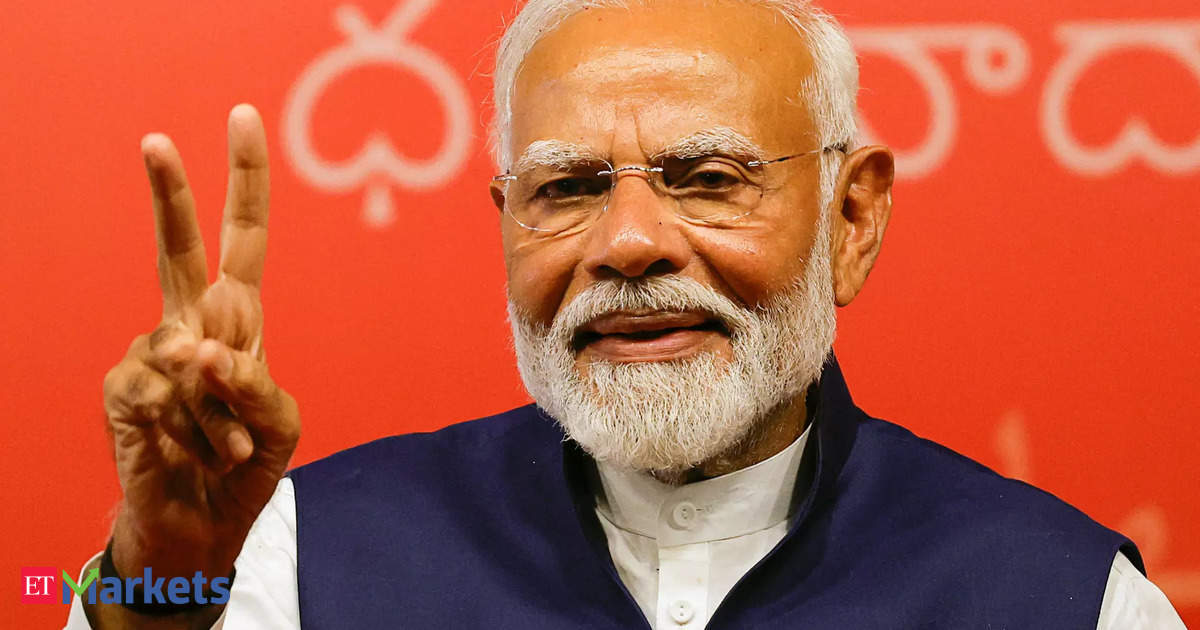
It’s been a turbulent week for Indian equities. After an initial surge Monday on the back of exit polls signaling a sweeping majority for Prime Minister Narendra Modi, markets crashed a day later erasing almost $400 billion of value as his party lost its majority in parliament.
While shares have recovered most of their losses after Modi won backing from key allies to form a government, stocks that are seen as fairly valued and less prone to sudden downturns are in favor.
Bloomberg
Here is how money managers of top Indian mutual funds are placing their bets:
“This was an event that told investors to take a closer look at what the reality of businesses are and their valuations. There was a perception of zero risk earlier, which is now gone”
For select of businesses, such as the ones linked to manufacturing or defense, the market was becoming “narrow, one-way” and too much money was chasing these sectors
“Now the approach must be about buying good businesses at sensible prices,” said Bhan, who also advises investors to diversify in case their portfolios are tilted largely toward equities
Large and mega caps are still reasonably valued and the fund house has already shifted to such stocks
Bhan expects capex-linked investments to continue to be preferred but also sees consumption theme catching up
Private sector banks, select consumer businesses like staples, foods and beverages and quick service restaurants are among preferred picks
Small and mid-sized firms haven’t been offering a “risk-return trade off” that would have made them attractive and hence caution was warranted on this segment
The asset manager remains bullish on domestic cyclicals, including automobiles, cement, and capital goods. “We like financials but are less excited about private banks and more positive on insurance and asset management companies”
Local manufacturing will continue to do well, driven by domestic demand. If the economy does well in terms of urbanization and housing, it will trigger demand for durable goods
Growth opportunities in India are very diversified and that’s why instead of focusing on just one theme, investors are better off focusing on quality of companies
“We need to look for companies that will be able to take advantage of these broad themes. That’s how an investment portfolio should be constructed”
“Cash levels continue to stay at slightly elevated levels in portfolio I manage because Indian markets are still trading at valuations higher than their long-period average. We have not been able to deploy all of our cash”
Mahesh Patil, chief investment officer, Aditya Birla Sun Life AMC; AUM: $18.8 billion
Some stocks in sectors such as industrials and defense have been trading ahead of their fundamentals and can potentially see a “sanity check”
For defense, the outlook for sector has also improved significantly and valuations have also gone higher.
“The government is looking at doing a lot of indigenous sourcing but the stocks were discounting too much in the future,” he said, adding some stocks in such sectors may see a “reset”
[hfe_template id='11223']
[ad_1]
Volatility in Indian equity markets has surged sharply over the past month, with the India VIX nearly doubling as geopolitical tensions and global uncertainty triggered aggressive selling in equities. India VIX, often referred to as the market’s fear gauge, has jumped close to 100% over the past month, reflecting growing nervousness among investors. The spike has coincided with a sharp correction in the broader market, with the Nifty 50 declining about 8% during the same period. The escalation of tensions involving the United States, Israel and Iran has intensified market anxiety in recent days, pushing crude oil prices sharply higher and triggering a global risk-off sentiment. However, analysts note that volatility had already been building even before the conflict escalated, reflecting broader concerns around global growth, foreign capital outflows and stretched valuations in equities. The heightened uncertainty translated into a sharp ...
[hfe_template id='11223']
[ad_1]
Benchmark indices Sensex and Nifty ended the week on a bearish note, closing over a percent lower each as a deepening selloff in IT stocks rattled investor sentiment amid mounting fears of AI-led disruption. Further, stronger-than-expected jobs data for January dampened hopes of a US Fed interest rate cut. Here are 7 factors that could decide market action in the coming week: 1.) Infosys, Wipro ADRs rebound - After a brutal two-day selloff that saw Infosys and Wipro ADRs plunge as much as 14.5%, Friday’s session brought a much-needed breather. Bargain hunting kicked in at lower levels, sparking a sharp rebound as Infosys climbed 3% while Wipro gained 4%—helping both stocks close the week on a far stronger note. International brokerage firm JP Morgan has a message for panic-stricken investors: IT services firms are the indispensable "plumbers of the tech world" and their dividend yields have now hit levels last seen only during ...
[hfe_template id='11223']
[ad_1]
Waaree Energies shares will be in focus on Wednesday after the solar panel maker reported a strong Q4 performance, with net profit rising 34.1% year-on-year (YoY) to Rs 618.9 crore for the quarter ended March 31, 2025. In the same quarter last year, the company had reported a profit of Rs 461.5 crore. Revenue from operations jumped 36.4% to Rs 4,003.9 crore, up from Rs 2,935.8 crore in the year-ago period, according to the company’s regulatory filing. EBITDA more than doubled to Rs 922.6 crore in Q4 FY25, up 120.6% from Rs 418.3 crore in the same quarter last year. The EBITDA margin improved to 23% from 14.3% a year ago. The company produced 2.06 GW of solar modules in the fourth quarter, up from 1.35 GW in the same period last year. For the full year, module production reached 7.13 GW, compared to 4.77 GW in FY24. For the full financial year FY25, revenue rose 27.62% YoY to Rs 14,846.06 crore. Profit after tax more than doubled to Rs 1,9...
 [hfe_template id='11223']
[ad_1]
[hfe_template id='11223']
[ad_1]
 Bloomberg


Comments
Post a Comment